
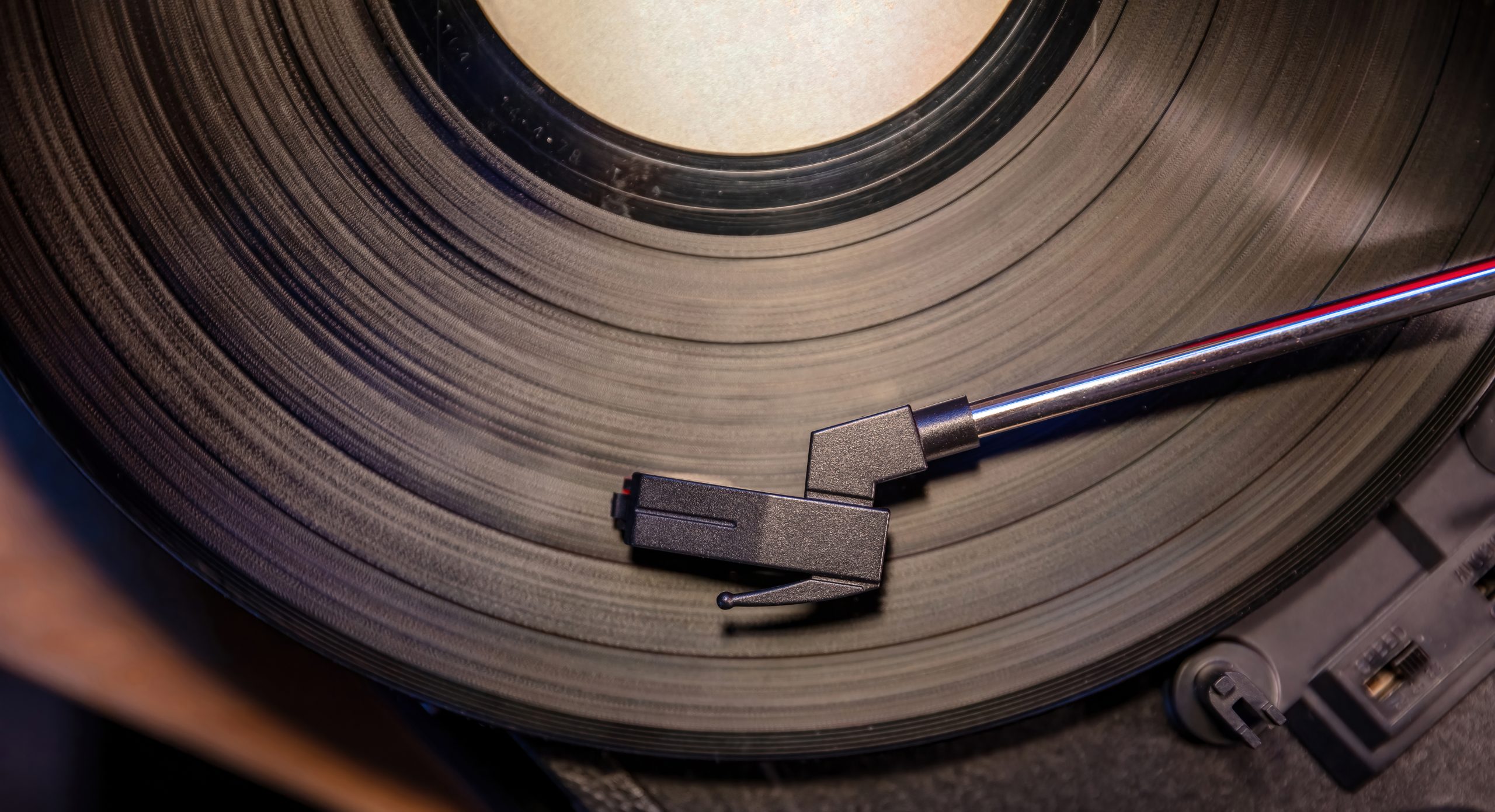
The Jukebox as Archive: Informal Memory Practices in the Rio Grande Valley

The Jukebox as Archive: Informal Memory Practices in the Rio Grande Valley
by Genesis Moreno, Texas Folklife Community Folklife Fellow
There was no official archive.
No room kept cold for preservation.
No names pinned to memory.
No one assigned to remember.
Still
something stayed.
In the soft crackle
of a record returning to itself.
In the way a song
refused to end
even after the room had emptied.
No one called it history.
But it lived
in the hands that reached for it again,
in the button pressed forward,
in the pause before selection.
In the body, mostly.
In the way people knew
when to sing
and when to stay quiet.
What remained
was not what was saved
but what refused to disappear.
This project lives in the Rio Grande Valley, specifically in McAllen, Tejas, where sound has always traveled faster than documentation.
The DLG Jukebox Project is an informal regional archive built from a collection of records once housed in jukeboxes across neighborhood cantinas.
These were not curated in the institutional sense. They were selected, in real time, by people moving through their lives: workers, families, regulars, migrants, drifters, lovers.
The community behind this work is layered and interconnected. It includes collectors, DJs, entrepreneurs, musicians, and those who grew up inside these sonic environments.
What binds them is not formal preservation, but shared memory. Songs chosen again, and again until they become part of the landscape itself.
This archive exists outside institutions, but not outside importance. It’s shaped by use, by repetition, and by the people who kept it alive without naming it as such.
How I Arrived Here
This project began indirectly.
I didn’t set out to document a jukebox archive. I was searching for something else. Mostly jazz records. That search led me deeper into record digging culture; a practice that has evolved over time through DJs, producers, and collectors.
What began in underground dance scenes, house music and hip-hop eventually became its own discipline, the act of searching for sound as a way of uncovering history, shaped by and reflective of marginalized communities whose stories were often left undocumented.
Somewhere along that path, my attention shifted.
I started looking not just for records, but for where they came from. Labels tied to South Texas. Pressings that circulated regionally. Music that existed close to home but had never been formally framed as significant (see tracklist attachment for examples)
And like most things in the Valley, one connection led to another.
It was inevitable to meet someone who had spent a lifetime collecting. Not for recognition, but because that was his way of holding onto the world. Through that circuit, I was introduced to a jukebox collection that had quietly preserved decades of local listening habits.
What I initially thought was a detour became the work itself.
Jukebox as Archive
The jukebox, in this context, isn’t just a machine. It’s a system of circulation and selection.
It determined what was heard, when it was heard, and how often. It allowed individuals to shape a shared environment one choice at a time. Over time, these selections formed patterns. Certain songs returned not because they were programmed to, but because people insisted on them.
A song played once is a request. A song played often becomes something else.
In these spaces, music moved with the room. It reflected mood, memory, and relationships. It created a form of informal authorship, one where the community collectively shaped its own soundtrack.
Key figures were not always visible: the jukebox owner, the collector maintaining the records, the regular who always chose the same track or the DJ who later carried those sounds into new contexts. Each plays a role in sustaining (the) tradition of El Disco Es Cultura.
Repetition as Memory
What appears as repetition from the outside functions as memory from within.
In institutional archives, preservation is controlled and deliberate. In these spaces, preservation happened through insistence. Through choosing the same song again and again, individuals reinforced its place in the room.
Over time, this created an informal canon not defined by critics or historians, but by lived experience. Repetition became a form of storytelling. A way of saying this mattered, this still matters, play it again.
This process also reflects the movement of people through South Texas. The region continues to grow, shaped by migration and economic opportunity. New communities arrive with their own sounds, while older ones leave traces behind.
For migrants, who are foundational to all places, sound carries what cannot always be written down. Language shifts. Geography changes. But a song remains, traveling across borders and generations.
Self Reflection
This project is both collective and personal.
As a Colombian-Tejano, I move between identities that are not always clearly defined. This work has become a way of navigating that space of understanding how culture is carried, adapted, and re-expressed over time (podcast link)
There is also something selfish in it.
A desire to understand where I belong within these histories. To trace a line between what I inherited and what I am still discovering. To build something that I wish had existed when I first started looking.
At the same time, this process has required letting go of traditional ideas of authority. I’m not creating this archive, I’m stepping into one that already exists. The responsibility is not to define it, but to listen carefully enough to carry it forward.
What Comes Next
The DLG Jukebox Project will continue through documentation, interviews, and public programming (example: La Tijera Gallery, Raices in Remix Exhibition)
Future work includes recording oral histories, digitizing portions of the collection, and creating listening spaces across the Rio Grande Valley such as Depósito: “El Nopalito” and beyond. As a DJ, I also carry these sounds into other cities, sharing them with new audiences and extending the reach of this regional story.
The goal for now isn’t to fix this archive in place, but to keep it in motion.
To make it accessible to those seeking to understand the history, music, and cultural identity of this region. To create pathways for discovery for those who grew up here, and for those just arriving because the archive was never missing.
It was always here waiting to be heard.
🜂 El disco es cultura
🜃 Todo el pueblo unido
🜄 Sin miedo, sin frontera
Written by Genesis Moreno desde las aguas del Río Grande Valle, Tejas pa’ todo el mundo! In loving memory of Maria del Socorro Moreno, February 20th, 1939 – March 6th 2026.
Track List
- El Prisionero- Conjunto Bernal, Bernal Records (McAllen, TX)
- Celos Mentirosos- Lydia Mendoza, Del Sur Records (Edinburg, TX)
- El Celoso- Los Coyotes De Elma y Goyo, Canasta Records (Kingsville, TX)
- Mucho Corazon- Steve Jordan, Hacienda Records (Corpus Cristi, TX)
- Corrido de Agustine Ramirez- Johnny Canales y Su Orquesta, Guti Records (Dallas, TX)
- Le Mentira- Conjunto Bernal, Bego Records (McAllen, TX)
- Hermosa y Bella- Los Fantasmas Del Valle, Cucuy Records (Mercedes, TX)
- El Gallo Herido- Los Lobos Del Norte, Puente Discos (Harlingen, TX)
- Vinos En Las Venas- Oscar Hernanez y Su Conjunto, Gar-Sen Records (Edinburg, TX)
- Me Agarro Contigo- Cornelio Reya, Bego Records (McAllen, TX)
- Mala Mujer- Kiko Montalvo, CRC Discos (McAllen, TX)
- El Parche- Los Fantasmas Del Valle, Canasta Records (Kingsville, TX)
- Una Palomite Triste- Pancho Garza y Los Amigos De Nuevo Leon, Del Sur Records (Edinburg, TX)
- Palabra De Hombre- Los Dos Gilbertos, Hacienda Records (Corpus Cristi, TX)
- Gozalo (Steve Jordan Cover)- The Animeros, Easy Eye Recording (Nashville, TN)
- El Magazo- Gustavo Pimentel, Orfeon (Mexico)
About Genesis Moreno
Desde las aguas del Río Grande, Genesis Moreno is a Colombian-Tejano cultural organizer, entrepreneur, and community archivist based out of la frontera in the Rio Grande Valley. His work operates at the intersection of record culture, oral history, and community-based folklife practice.
He is the founder of Depósito El Nopalito, a wine shop, hi-fi listening space, and cultural incubator in McAllen, and Liberate Ediciones, a nonprofit publishing and programming initiative dedicated to documenting and amplifying regional voices. Through projects such as Wasteland Zine and Record Fest, Moreno advances community rooted approaches to preserving the living musical traditions of South Texas and the United States-Mexico borderlands.
At El Nopalito, Moreno has helped establish the space as an informal Mexican American regional archive, maintaining and circulating recordings connected to influential labels including Falcon, DLV, De La Rosa, and Bego. His broader practice reflects a range of proficiencies spanning entrepreneurial development and cultural innovation, creating environments where community memory, commerce, and creative expression coexist and grow.
In partnership with the City of San Benito, Moreno supports the continued legacy of Market Days on Robertson Street, expanding opportunities for small vendors and public cultural programming. He also launched a seasonal Friday Night Art series at El Nopalito in response to a regional gap in accessible gallery space, an effort that helped catalyze renewed momentum for artist-led programming across the region.
Extending this ecosystem approach, Moreno supports emerging culinary pathways through collaborations with Malaquite inside Bandera Coffee and Ramen Prosper, currently in residence at Depósito El Nopalito. He is also an active supporter of Texas wine growers and has worked with producers including Soto Vino and The Austin Winery.
Moreno’s work treats everyday gathering spaces as living sites of folklife where sound, memory, and community remain in active circulation.
![[Laura Yohualtlahuiz] wears an elaborate Mexica danza headdress with long feathers radiating outward in orange, red, and pink alongside brown-and-white patterned feathers. A beaded headband with colorful floral and geometric designs frames her face, which is marked with red linear face paint. She wears a gold septum ring and shell earrings, with a tattoo visible on one arm and a green and yellow patterned top. Warm lights glow in the background.](https://texasfolklife.org/wp-content/uploads/2026/08/Laura_Atlachinolli-150x150.jpg)