A Shared Cosmovisión: Transnational Plant Lives in Houston’s Greater East End

A Shared Cosmovisión: Transnational Plant Lives in Houston’s Greater East End
by Alba Donajhi Sereno, Texas Folklife Community Folklife Fellow
During my years working on anti-displacement efforts in Texas, I witnessed a recurring botanical erasure. In historically Brown neighborhoods, I saw and lived how gentrifiers inherited centennial agaves and nopales (cacti), sentient witnesses and partners in generations of family life. Too often, these plant relatives were uprooted or flattened into a generic Southwestern aesthetic. This botanical colonization mirrored the dispossession of the people themselves; a living heritage was reduced to a disposable commodity and a functioning ecosystem was replaced by static lawns or gravel.
Half a decade ago, as a newcomer to Houston’s Greater East End, I found an accidental homeland, with transnational people (people who maintain ties with both a community of origin and a new community across nations, beyond and despite borders) of similar backgrounds, and witnessed some of the same dynamics. So, I turned to my neighborhood and neighbors, and through oral history interviews on the transnational experience and plantways (traditional practices, knowledge, and relationships that indigenous communities hold with plants, including but not limited to food, medicine, and cultural ways), I sought to honor my community, my own family, and our extended web of beyond human relatives. The interviews documented different aspects of historical and shared experiences of the people of Houston’s Greater East End, and a shared cosmovisión: a worldview where we do not garden, but rather participate in a complex, multi and interspecies existence. In this transnational landscape, we are not managers of a plot, but members of an ecosystem and ancestral identity. We are participants in natural cycles that transcend borders.
Conducting these interviews in home green spaces and at the Houston Farmers Market (culturally relevant spaces for Texas-Mexicans (see https://adanmedrano.com/ for more on Texas-Mexicans) who have traversed these lands for time in memorial) allowed me to honor these sites as living archives. By recording stories in situ (in place/on site), I documented the full sonic ecology of the place: the rustle of leaves and the rhythm of hands in the dirt, the flight of herons, the click of the grackle, and whistle of the trains, all constant features of Houston’s Greater East End. My podcast episode of The Folklorist Next Door: Our Transnational Plant Lives frames these spaces as vital nodes of communal sovereignty. From these conversations with neighbors, three distinct roles for humans emerged, all bound by the understanding of the plantways practitioner as a vital part of the web of life:
Part 1: The Hidden Healer
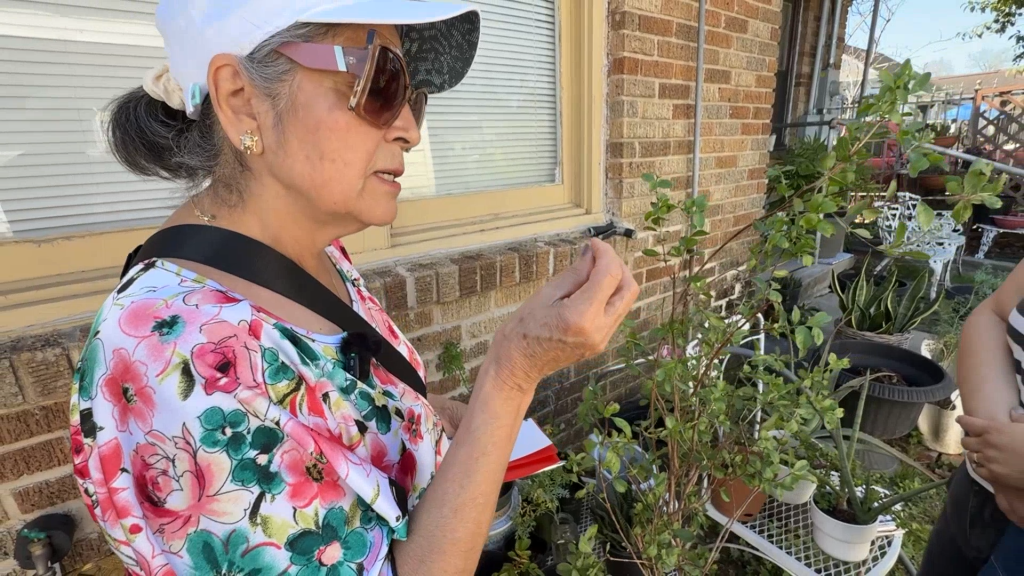
Doña Olivia, a traditional healer, does not simply grow plants; she facilitates an exchange of cross species healing. Her “backyard” is a healthy micro-ecosystem where plant relatives like ruda (rue), aloe, and hierbabuena (Mexican mint) act as elder teachers. Central to her practice is the memory held in her hands and heart for the treatment of susto (soul fright) through plant-based barridas (somatic healing of the body with plants). This practice acknowledges that plants possess agency and spirit. In our cosmovisión, we work in collaboration with plant relatives to facilitate the restoration of equilibrium to the human body and the spirit. It is a symbiotic dialogue between two living beings, the human and the plant kin, and it is the plant who holds the healing power, and agency to heal. It is a plant who can give much, or not at all if the human does not deliver on its duty of relational care.
Part 2: The Memory Keeper
For Laura, the memory keeper (see Laura’s work here), the ecosystem is a vessel for genealogy, to “honor lives lived and still living”. Her grandmother’s backyard was a refuge, a sovereign space that provided safety for her and her family when public spaces were hostile. The banana grove was central to this refuge, a place where a younger Laura could freely use her imagination, and absorb family knowledge from both of her grandparents. Today the descendants of the banana plants that held her family as they adjusted and fought to thrive in their trajectory from their communities in México to the Port of Houston have returned to her own front yard. The reclamation of her grandmother’s banana grove is not gardening, rather, she is performing a public act of familial reunion. She is reconnecting a temporarily fragmented ecological lineage, asserting that these plant relatives are essential participants in our shared survival.
Part 3: The World Sculptor
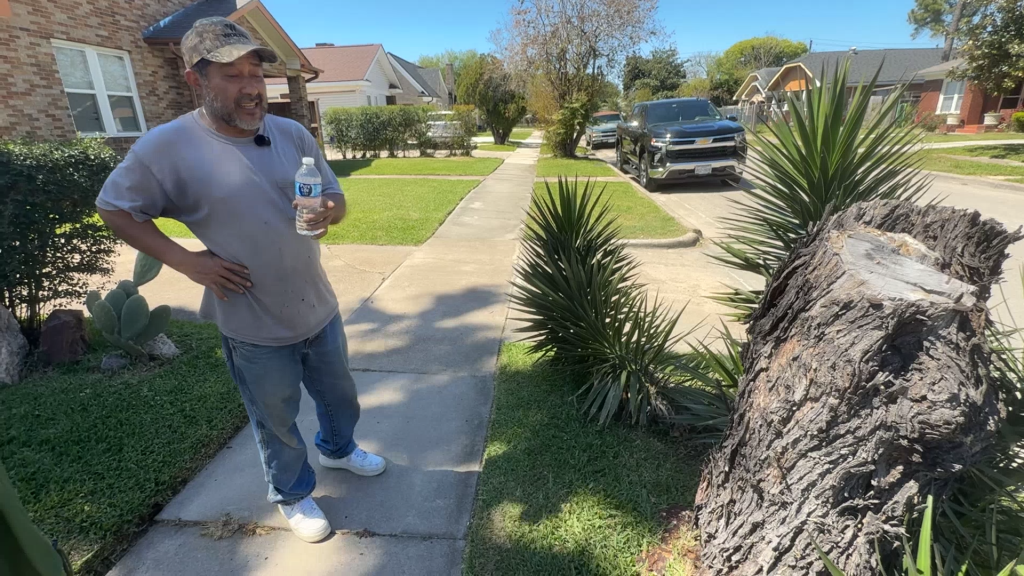
Don Armando, our neighborhood’s world sculptor, shapes our local ecosystem informed by his greater communal context which extends to the mountains and valleys of San Luis Potosí. He uses his skills of perception and vision, cultivated in him by his parents in his early childhood. Perception is the skill of witnessing the lives of plant relatives and understanding their “intentions” as he frames it, vision is the taking of the long view, purposefully placing plant relatives across the neighborhood canopy and underbed to support both human and non-human life.
His further practice of plant transnationalism involves a profound responsibility to his peach tree lineage, preserving seeds in Houston as a biological fail-safe for his drought-stricken community of origin. Don Armando’s work is a rejection of the colonial view of the isolated, aristocratic lawn. He recognizes, as taught by his elders and antepasados (his elders’ elders, ancestors) that we are integrated into the cycle of our planetary system, and seeks to recreate a version of the communal ejido (lands communally held by indigenous communities, legally codified post Mexican Revolution as a key part of the long and continued communal exit from colonization). By moving each plant to its optimal place, and setting the stage for community thrivingness, he ensures the entire system reaches a state of flourishing.
Historical Context: The Dual Reality of Houston’s Greater East End
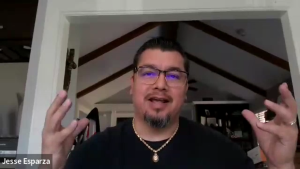
To further ground our histories, I spoke with Dr. Jesus Esparza, historian, of Texas Southern University (see interview excerpt here, see full interview here). Our conversation provided the historical context for understanding the reality of Houston’s Latiné community and helped me synthesize the following insights regarding my community’s ecosystemic, cosmovisión informed practices:
- Systematic hostility and nativism in Houston-anti-immigrant sentiment in Houston is not a passing phase but a persistent reality. Mexican Americans have faced persistent nativism (political, social ideologies or policies that favor native-born/long-established residents over those of immigrants) regardless of their citizenship status, they are frequently forced to prove their belonging. This hostility manifested through immigration sweeps increased in the 1960s and ’70s, fueled by the arrival of Central American immigrants and a desire to criminalize Spanish-speaking neighbors/neighborhoods. Both immigration crackdowns and police brutality have been deliberate tools used to suppress the gains of the Chicano Movement and civil rights activism. This parallels current dynamics in Houston.
- The Dual Reality: Front Yard vs. Backyard– In the face of nativism, Latiné families often curated their public presentation as a means of survival. As observed with neighbors in the Greater East End, the backyard (and kitchen) remained a sacred, autonomous node. In private space, families grew/grow traditional foods and medicinal plants away from the public eye. This allows for the continuance of a cosmovisión that saw plants as essential partners in survivance and thrivingness rather than as ornamental.
- Interspecies kinship as resistance– Due to nativism, some families may have avoided grocery stores because they did not feel safe in public spaces. Growing one’s own food provides a way to bypass high costs and stay within a limited budget. Growing traditional plants like aguacates (avocados) and acts like preparing mole are not a hobby, they are a multi-layered acts of survival and defiance. In our private green spaces, we engage in direct communion with the relatives who have sustained our metabolic and cultural needs for thousands of years, a direct and continued pushback to loss of ancestral land, corporatization, consumerism, and a capitalist world that treats life as a product.
The Accidental Homeland
My neighbors and I are a people, we are wisdom keepers of our plantways and interspecies kinship holders, members of a shared ancestral identity, ecosystem, and cosmovisión which geographically includes the Greater East End but ultimately spans across socially constructed national borders that have shifted across time. Through these oral histories I have fortified my understanding that my neighborhood is not just a place I moved to, it is a part of my transnational homeland and an ecosystem I must be a part of.
These interviews have called me to action. By weaving our narratives together and leaning on ancestral wisdom, we are doing more than surviving; we are using our hands and our shared lifeways to grow a future where we are no longer and not just owners of the land, but humble participants in earth’s life.
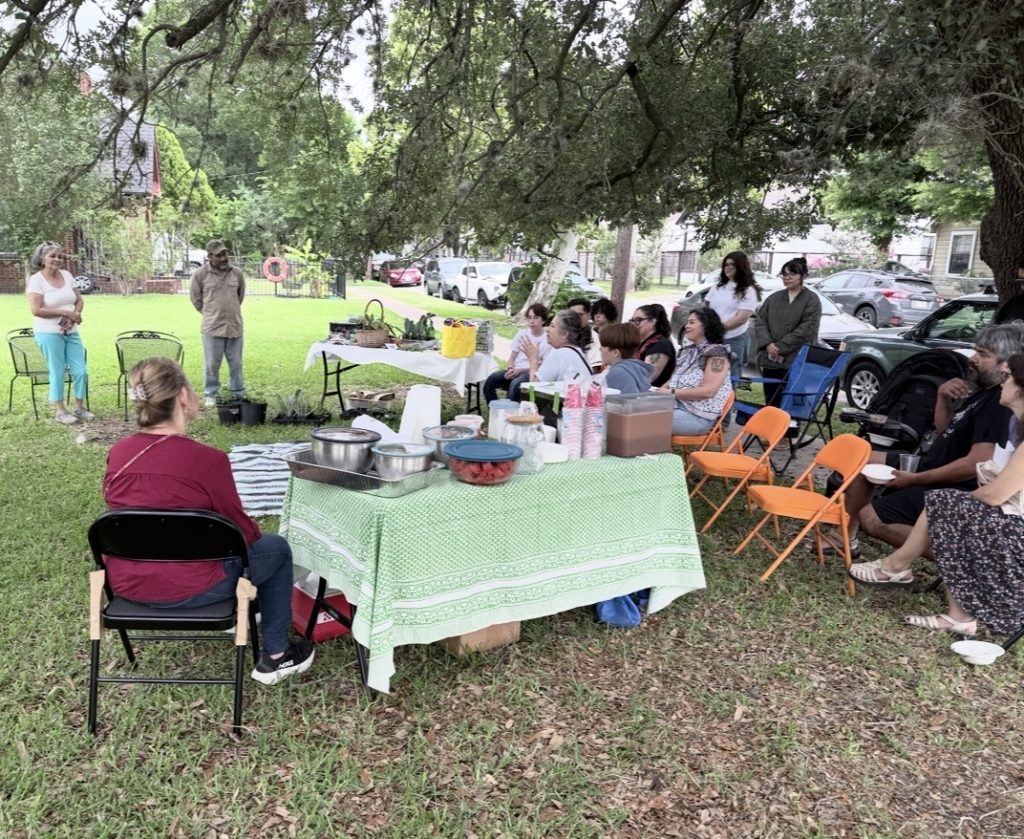
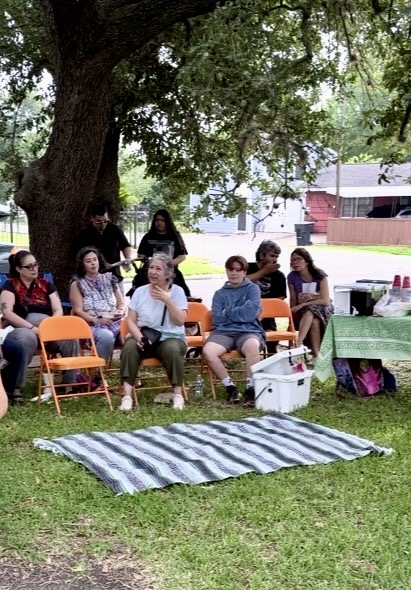
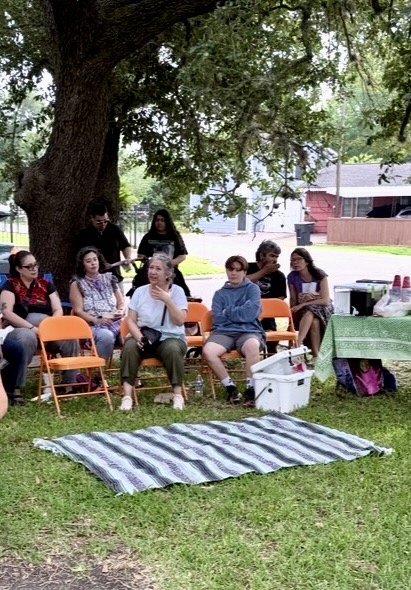
Our Mitote Milpero, a seed, plant and ancestral knowledge exchange, held as a part of this fellowship has given us a foothold forward into future seasons. May the next moon phases bring to life our community milpa (traditional Mesoamerican ecosystem, the milpa is a key part of Indigenous food security, biodiversity, and cultural heritage in México and Central America) and tianguis (a traditional open-air street market or bazaar, with roots in the pre-Hispanic era, commonly found in México and Central America, it pops up on specific days in different neighborhoods) in the Greater East End, ensuring we and our plant relatives continue to flourish, hand to hand, seed to seed, and generation to generation.
About Alba Donajhi Sereno
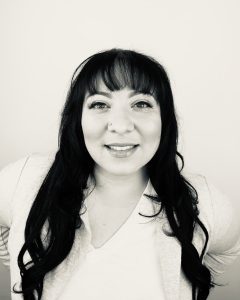
Through oral histories in Houston’s East End, Alba Donajhi Sereno, Community Folklife Fellow, weaves plant-human relationships sustaining Latiné collective memory and cultural sovereignty. Alba is an emerging cultural worker and longtime community worker. A student of the plants and ancestral ways, she cultivates transnational roots to reclaim ancestral wisdom against a backdrop of migration and neighborhood change.
Follow Alba on Instagram: @studioentrepalmas.
Learn More | Más información
Over the last decade plus, I have gathered a personal library that informs my thinking on the above topics, here is a small portion of that library for those interested in further reading/listening.
A lo largo de la última década y pico, he reunido una biblioteca personal que ha influido en mi forma de pensar sobre los temas mencionados anteriormente; a continuación, incluyo una pequeña selección de esa biblioteca para quienes estén interesados en ampliar sus lecturas o escuchas:
Plant Kinship, Indigenous Knowledge, Memory & Wisdom
- Adán Medrano on Food and Culture, Adán Medrano https://adanmedrano.com/truly-texas-mexican-ovie/
- Becoming Kin, Patty Krawec https://www.broadleafbooks.com/store/productgroup/3587/Becoming-Kin
- Bless Me, Ultima, Rudolfo Anaya https://www.loa.org/books/715-bless-me-ultima-tortuga-alburquerque/
- Braiding Sweetgrass, Robin Wall Kimmerer https://milkweed.org/book/braiding-sweetgrass
- Canto de Cenzontles, https://cantodecenzontles.org/quienes-somos/
- Dispersals, Jessica J. Lee https://www.jessicajleewrites.com/dispersals
- Fresh Banana Leaves, Jessica J. Hernandez https://pendlehill.org/product/fresh-banana-leaves-healing-indigenous-landscapes-through-indigenous-science/
- Mapping Memory, Space and History in 16th-century Mexico, Blanton Museum of Art https://blantonmuseum.org/exhibition/mapping-memory/
- Museo Indígena. Antigua Aduana de Peralvillo, https://www.inpi.gob.mx/museoindigena/
- Theory of Water, Nishnaabe Maps to the Times Ahead, Leanne Betasamosake Simpson, https://www.haymarketbooks.org/books/2533-theory-of-water
Botanical Colonization, Colonization, (Urban) Settler-Colonialism, Displacement, Gentrification, Transnationalism
- Against Bio Pirates, Radio Ambulante https://radioambulante.org/en/audio-en/against-biopirates
- Austin In Photos: What Gentrification has done to East Austin, Austin Monthly https://www.austinmonthly.com/in-photos-what-gentrification-has-done-to-east-austins-rich-culture/
- Indian Botanical Art, Martin Ryx, Kew Royal Botanic Gardens https://shop.kew.org/indian-botanical-art-an-illustrated-history?srsltid=AfmBOorZEdt0s27ILqZM0GNA-ymVdVHXctHDcKQfC74i7V752Xib_uNN
- Gentrification as (settler) colonialism? Moving beyond metaphorical linkages, Margaret Ellis-Young https://compass.onlinelibrary.wiley.com/doi/epdf/10.1111/gec3.12604
- La guerra contra los indígenas del norte en las primeras décadas del México independiente, Gobierno de México, https://www.gob.mx/agn/articulos/la-guerra-contra-los-indigenas-del-norte-en-las-primeras-decadas-del-mexico-independiente?idiom=es
- Rasgos Asiaticos, Virginia Grise https://diverseworks.org/past-works/archive/virginia-grise-rasgos-asiaticos/
- Rethinking History & the Nation State: Mexico and the United States, a special issue of the Journal of American History, Journal of American History, https://archive.oah.org/special-issues/mexico/about.html
- Transnational People, Richard T. Schaffer, Encyclopedia of Race and Ethnicity, https://sk.sagepub.com/ency/edvol/ethnicity/chpt/transnational-people
- The Right to Stay Home: How US Policy Drives Mexican Migration, David Beacon https://www.beacon.org/The-Right-to-Stay-Home-P1055.aspx
- Why We Have Lawns, Braelei Hardt, The National Wildlife Federation https://blog.nwf.org/2024/04/why-we-have-lawns/
-
Latiné History & Experience in Houston & Texas
- La Colonia Mexicana: A History of Mexican Americans in Houston
Jesus Esparza, Houston History Magazine https://houstonhistorymagazine.org/wp-content/uploads/2012/03/Esparza-La-Colonia-Mexicana.pdf - The History and Cultural Identity of Tejanos in Texas, Arnoldo De León, Texas State Historical Association https://www.tshaonline.org/handbook/entries/mexican-americans
- The Truth in Our Stories: Immigrant Voices in Radical Times, Jesus Esparza https://experts.tsu.edu/en/publications/the-truth-in-our-stories-immigrant-voices-in-radical-times/
- La Colonia Mexicana: A History of Mexican Americans in Houston
Versión en español a continuación
Una cosmovisión compartida: nuestras vidas transnacionales con las plantas en el Greater East End de Houston
por Alba Donajhi Sereno, Community Folklife Fellow (becaria de folclore comunitario) de Texas Folklife
Durante los años que trabajé en iniciativas contra el desplazamiento en Tejas, fui testigo de una supresión/borazon botánica. En barrios históricamente de población Latiné , vi y viví cómo los gentrificadores se apropiaban de agaves y nopales centenarios, testigos vivos y compañeros de generaciones de vida familiar. Con demasiada frecuencia, estas plantas fueron arrancadas de raíz o aplastadas para dar paso a una estética genérica del suroeste. Esta colonización botánica refleja el despojo de las propias personas; un patrimonio vivo queda reducido a una mercancía desechable y un ecosistema funcional es sustituido por céspedes estáticos o grava.
Hace media década, cuando acababa de llegar al Greater East End de Houston, encontré una patria accidental junto a personas transnacionales (personas que mantienen vínculos tanto con una comunidad de origen como con una nueva comunidad al otro lado de las fronteras, más allá de estas y a pesar de ellas) de orígenes similares, y fui testigo de algunas de las mismas dinámicas. Así que me centré en mi barrio y en mis vecinos, y a través de entrevistas de historia oral sobre la experiencia transnacional y los modos de vida con las plantas (prácticas tradicionales, conocimientos y relaciones que las comunidades indígenas mantienen con las plantas, incluyendo, entre otros, la alimentación, la medicina y las formas culturales), busqué honrar a mi comunidad, a mi propia familia y a nuestra amplia red de parientes más allá de lo humano. Las entrevistas documentaron diferentes aspectos de las experiencias históricas y compartidas de la gente del Greater East End de Houston, y una cosmovisión compartida: una visión del mundo en la que no cultivamos un jardín, sino que participamos en una existencia compleja, multi especiaria entre especies. En este paisaje transnacional, no somos administradores de una parcela, sino miembros de un ecosistema y de una identidad ancestral. Somos participantes en ciclos naturales que trascienden las fronteras.
Realizar estas entrevistas en los espacios verdes de los hogares y en el Houston Farmers Market (espacios culturalmente relevantes para los tejano-mexicanos [véase https://adanmedrano.com/ para más información sobre los tejano-mexicanos], que han recorrido estas tierras desde tiempos inmemoriales) me permitió honrar estos lugares como archivos vivos. Al grabar las historias in situ (en el lugar), documenté toda la ecología sonora del lugar: el susurro de las hojas y el ritmo de las manos en la tierra, el vuelo de las garzas, el graznido del zanate y el silbido de los trenes, los elementos sonoros constantes del Greater East End de Houston. Mi episodio del podcast The Folklorist Next Door: Nuestras vidas transnacionales con las plantas enmarca estos espacios como nodos vitales de soberanía comunitaria. De estas conversaciones con los vecinos surgieron tres roles distintos para los seres humanos, todos ellos vinculados por la comprensión de que el practicante de la vida tradicional con las plantas es una parte vital de la red de la vida:
Parte 1: La sanadora escondida
Doña Olivia, una sanadora tradicional, no se limita a cultivar plantas; facilita un intercambio de sanación entre especies. Su «patio trasero» es un microecosistema saludable donde nuestros parientes botánicos, como la ruda, el aloe y la hierbabuena actúan como maestras ancestrales. Un elemento central de su práctica es la memoria que guarda en sus manos y en su corazón del tratamiento para el susto (miedo del alma) a través de las barridas a base de plantas (curación somática del cuerpo con plantas). Esta práctica reconoce que las plantas poseen agencia y espíritu. En nuestra cosmovisión, trabajamos en colaboración con las plantas para facilitar el restablecimiento del equilibrio del cuerpo humano y el espíritu. Se trata de un diálogo simbiótico entre dos seres vivos, el ser humano y la planta, y es la planta la que posee el poder curativo y la capacidad de sanar. Es la planta la que puede dar mucho, o nada en absoluto, si el ser humano no cumple con su deber de cuidado relacional.
Parte 2: La guardiana de la memoria
Para Laura, la guardiana de la memoria (véase el trabajo de Laura aquí), el ecosistema es un vehículo para la genealogía, para «honrar las vidas vividas y las que aún viven». El patio trasero de su abuela era un refugio, un espacio soberano que les proporcionaba seguridad a ella y a su familia cuando los espacios públicos eran hostiles. El platanal era fundamental para este refugio, un lugar donde la joven Laura podía dar rienda suelta a su imaginación y absorber los conocimientos familiares de sus dos abuelos. Hoy, los descendientes de las plantas de plátano que acogieron a su familia mientras se adaptaban y luchaban por prosperar en su trayectoria desde sus comunidades en México hasta el puerto de Houston han regresado a su propio patio delantero. La recuperación del platanero de su abuela es más que jardinería, es un acto público de reencuentro familiar. Está reconectando un linaje ecológico temporalmente fragmentado, afirmando que estos parientes botánicos son participantes esenciales en nuestra supervivencia compartida.
Parte 3: El escultor de mundos
Don Armando, el escultor de mundos de nuestro barrio, da forma a nuestro ecosistema local inspirándose en un contexto comunitario más amplio que se extiende hasta las montañas y los valles de San Luis Potosí. Para ello, recurre a sus habilidades de percepción y visión, que le inculcaron sus padres en su primera infancia. La percepción es la habilidad de ser testigo de las vidas de nuestros parientes botánicos y comprender sus «intenciones», tal y como él lo define; la visión es adoptar una perspectiva a largo plazo, colocando deliberadamente nuestros parientes botánicos a lo largo del vecindario y bajo el arbolado para sustentar tanto la vida humana como más que humana.
Su práctica adicional del transnacionalismo botánico implica una profunda responsabilidad hacia su linaje de duraznos, preservando semillas en Houston como un sistema de respaldo biológico para su comunidad de origen, que sufre sequías. El trabajo de Don Armando es un rechazo a la visión colonial del césped aislado y aristocrático. Reconoce, tal y como le enseñaron sus antepasados (los mayores de sus mayores, sus ancestros) que estamos integrados en el ciclo de nuestro sistema planetario, y busca recrear una versión del ejido comunal (tierras de propiedad comunal de las comunidades indígenas, codificadas legalmente tras la revolución Mexicana como parte clave de la larga y continua salida comunal de la colonización). Al trasladar cada planta a su lugar óptimo y sentar las bases para la prosperidad de la comunidad, se asegura de que todo el sistema alcance un estado de plenitud.
Contexto histórico: La doble realidad del Greater East End de Houston
Para profundizar aún más las entrevistas, hablé con el Dr. Jesús Esparza, historiador de la Texas Southern University (véase un extracto de la entrevista aquí; véase la entrevista completa aquí). Nuestra conversación proporcionó el contexto histórico necesario para comprender la realidad de la comunidad Latiné de Houston y me ayudó a sintetizar los siguiente sobre las prácticas de mi comunidad, basadas en una cosmovisión y un enfoque ecosistémico:
- La hostilidad sistemática y el nativismo en Houston: el sentimiento antiinmigrante en Houston no es una fase pasajera, sino una realidad persistente. Los mexicoamericanos se han enfrentado a un nativismo persistente (ideologías o políticas sociales que favorecen a los residentes nativos o establecidos desde hace tiempo frente a los inmigrantes), independientemente de su estatus de ciudadanía, y con frecuencia se ven obligados a demostrar su pertenencia a la comunidad. Esta hostilidad, que se manifestaba a través de redadas de inmigración, se intensificó en las décadas de 1960 y 1970, impulsada por la llegada de inmigrantes centroamericanos y el deseo de criminalizar a los vecinos y barrios de habla hispana. Tanto las medidas de represión contra la inmigración como la brutalidad policial han sido herramientas deliberadas utilizadas para suprimir los logros del Movimiento Chicano y el activismo por los derechos civiles. Esto es paralelo a la dinámica actual en Houston.
- La doble realidad: el jardín delantero frente al patio trasero. Ante el nativismo, las familias latinas solían cuidar su imagen pública como medio de supervivencia. Tal y como se observó entre los vecinos del Greater East End, el patio trasero (y la cocina) seguían siendo un espacio sagrado y autónomo. En el ámbito privado, las familias cultivaban y cultivan alimentos tradicionales y plantas medicinales lejos de la mirada pública. Esto permite la continuidad de una cosmovisión que consideraba a las plantas como aliadas esenciales para la supervivencia y la prosperidad, más que como elementos ornamentales.
- El parentesco entre especies como forma de resistencia: debido al nativismo, es posible que algunas familias hayan evitado los supermercados porque no se sentían seguras en los espacios públicos. Cultivar los propios alimentos ofrece una forma de eludir los altos costes y ajustarse a un presupuesto limitado. Cultivar plantas tradicionales como los aguacates o preparar mole no es un simple pasatiempo, sino un acto multifacético de supervivencia y rebeldía. En nuestros espacios verdes privados, nos relacionamos directamente con los parientes no humanos que han sustentado nuestras necesidades metabólicas y culturales durante miles de años, lo que supone una respuesta directa y continua a la pérdida de las tierras ancestrales, la corporativización, el consumismo y un mundo capitalista que trata la vida como un producto.
La patria accidental
Mis vecinos y yo formamos un pueblo; somos guardianes de la sabiduría de nuestros modos de vida con las plantas y portadores de los lazos de hermandad entre especies, miembros de una identidad ancestral compartida, de un ecosistema y de una cosmovisión que, geográficamente, abarca el Greater East End, pero que, fundamentalmente, van más allá de las fronteras nacionales construidas sociológicamente, las cuales han variado a lo largo del tiempo. A través de estas historias orales he reforzado mi comprensión de que mi barrio no es solo un lugar al que me mudé, sino que es parte de mi patria transnacional y un ecosistema del que debo formar parte.
Estas entrevistas me han impulsado a la acción. Al entrelazar nuestras narrativas y apoyarnos en la sabiduría ancestral, estamos haciendo algo más que sobrevivir; estamos utilizando nuestras manos y nuestros modos de vida compartidos para cultivar un futuro en el que no somos solo propietarios de la tierra, sino humildes participantes en la vida de la Tierra.
Nuestro Mitote Milpero, un intercambio de semillas, plantas y conocimientos ancestrales organizado como parte de esta beca, nos ha proporcionado un punto de apoyo para avanzar hacia las próximas estaciones. Que las próximas lunas den vida a nuestra milpa comunitaria (ecosistema tradicional mesoamericano; la milpa es un elemento clave para la seguridad alimentaria, la biodiversidad y el patrimonio cultural en México y Centroamérica) y nuestro tianguis (un mercado o bazar tradicional al aire libre, con raíces en la era prehispánica, común en México y Centroamérica, que se monta en días específicos en diferentes barrios) en el Greater East End, asegurando que nosotros y nuestras plantas hermanas sigamos floreciendo, mano a mano, semilla a semilla y generación tras generación.
Sobre Alba Donajhi Sereno
A través de historias orales del East End de Houston, Alba Donajhi Sereno, becaria de Texas Folklife, teje las relaciones entre las plantas y los seres humanos que sustentan la memoria colectiva y la soberanía cultural de la comunidad Latiné . Alba es una trabajadora cultural emergente y una trabajadora comunitaria con una larga trayectoria. Como estudiante de las plantas y las tradiciones ancestrales (barro), cultiva raíces transnacionales para recuperar la sabiduría ancestral en un contexto de migración y cambios en el barrio.
Sigue a Alba en Instagram: @studioentrepalmas
Learn More | Más información
Over the last decade plus, I have gathered a personal library that informs my thinking on the above topics, here is a small portion of that library for those interested in further reading/listening.
A lo largo de la última década y pico, he reunido una biblioteca personal que ha influido en mi forma de pensar sobre los temas mencionados anteriormente; a continuación, incluyo una pequeña selección de esa biblioteca para quienes estén interesados en ampliar sus lecturas o escuchas:
El parentesco con las plantas, el conocimiento indígena, la memoria y la sabiduría
- Adán Medrano on Food and Culture, Adán Medrano https://adanmedrano.com/truly-texas-mexican-ovie/
- Becoming Kin, Patty Krawec https://www.broadleafbooks.com/store/productgroup/3587/Becoming-Kin
- Bless Me, Ultima, Rudolfo Anaya https://www.loa.org/books/715-bless-me-ultima-tortuga-alburquerque/
- Braiding Sweetgrass, Robin Wall Kimmerer https://milkweed.org/book/braiding-sweetgrass
- Canto de Cenzontles, https://cantodecenzontles.org/quienes-somos/
- Dispersals, Jessica J. Lee https://www.jessicajleewrites.com/dispersals
- Fresh Banana Leaves, Jessica J. Hernandez https://pendlehill.org/product/fresh-banana-leaves-healing-indigenous-landscapes-through-indigenous-science/
- Mapping Memory, Space and History in 16th-century Mexico, Blanton Museum of Art https://blantonmuseum.org/exhibition/mapping-memory/
- Museo Indígena. Antigua Aduana de Peralvillo, https://www.inpi.gob.mx/museoindigena/
- Theory of Water, Nishnaabe Maps to the Times Ahead, Leanne Betasamosake Simpson, https://www.haymarketbooks.org/books/2533-theory-of-water
Colonización botánica, colonización, colonialismo de colonos (urbano), desplazamiento, gentrificación, transnacionalismo
- Against Bio Pirates, Radio Ambulante https://radioambulante.org/en/audio-en/against-biopirates
- Austin In Photos: What Gentrification has done to East Austin, Austin Monthly https://www.austinmonthly.com/in-photos-what-gentrification-has-done-to-east-austins-rich-culture/
- Indian Botanical Art, Martin Ryx, Kew Royal Botanic Gardens https://shop.kew.org/indian-botanical-art-an-illustrated-history?srsltid=AfmBOorZEdt0s27ILqZM0GNA-ymVdVHXctHDcKQfC74i7V752Xib_uNN
- Gentrification as (settler) colonialism? Moving beyond metaphorical linkages, Margaret Ellis-Young https://compass.onlinelibrary.wiley.com/doi/epdf/10.1111/gec3.12604
- La guerra contra los indígenas del norte en las primeras décadas del México independiente, Gobierno de México, https://www.gob.mx/agn/articulos/la-guerra-contra-los-indigenas-del-norte-en-las-primeras-decadas-del-mexico-independiente?idiom=es
- Rasgos Asiaticos, Virginia Grise https://diverseworks.org/past-works/archive/virginia-grise-rasgos-asiaticos/
- Rethinking History & the Nation State: Mexico and the United States, a special issue of the Journal of American History, Journal of American History, https://archive.oah.org/special-issues/mexico/about.html
- Transnational People, Richard T. Schaffer, Encyclopedia of Race and Ethnicity, https://sk.sagepub.com/ency/edvol/ethnicity/chpt/transnational-people
- The Right to Stay Home: How US Policy Drives Mexican Migration, David Beacon https://www.beacon.org/The-Right-to-Stay-Home-P1055.aspx
- Why We Have Lawns, Braelei Hardt, The National Wildlife Federation https://blog.nwf.org/2024/04/why-we-have-lawns/
Historia y experiencia de Latinés en Houston y Texas
- La Colonia Mexicana: A History of Mexican Americans in Houston
Jesus Esparza, Houston History Magazine https://houstonhistorymagazine.org/wp-content/uploads/2012/03/Esparza-La-Colonia-Mexicana.pdf - The History and Cultural Identity of Tejanos in Texas, Arnoldo De León, Texas State Historical Association https://www.tshaonline.org/handbook/entries/mexican-americans
- The Truth in Our Stories: Immigrant Voices in Radical Times, Jesus Esparza https://experts.tsu.edu/en/publications/the-truth-in-our-stories-immigrant-voices-in-radical-times/