

Breaking Bread and Building Bonds with Pan de Campo: A Taste of Tradition

By Elizabeth Barger
I’m a storyteller. I have been one for more than 20+ years, but not the storyteller that you might think. I’m a storyteller to littles, aka, Kindergarten students in Corpus Christi, Texas. I’m dramatic. I make faces, and I use my hands A LOT. These stories are usually from children’s books. Sometimes I narrate an anecdote from my family, my dog, or or anything that comes to my mind.
Now it’s time to tell a different story, my family’s story in South Texas. It starts where many stories begin, with food. This story is about a tradition in Texas, pan de campo, sometimes called cowboy bread or camp bread. I grew up eating it. My dad made it. My uncles made it, my grandfather made it, and many other relatives have made it.
The History of Pan de Campo during the Cattle Roundups
To people accustomed to the modern city life, cattle drives are difficult now to imagine. Around the 1860’s, the cowboys, or vaqueros, would round up the cattle to various destinations twice a year. Cowboys on horseback would be shouting and guiding the cattle with their lassos. After a day of hard labor, the ‘vaqueros’ would enjoy a meal of pan de campo with rice and beans, sometimes meat if they had it. Because of its simple ingredients, flour, water, salt, lard, and sometimes baking powder, pan de campo became a staple in the ranching life. It was made in a cast iron skillet, or Dutch oven, outside on top of coals. Pan de campo became the official state bread of Texas in 2005.


The Armstrong Ranch
My mom, Lucy Torres, grew up on the Armstrong Ranch, a ranch about 65 miles from Corpus Christi, Texas. I loved visiting my grandparents on the Armstrong Ranch. We often visited during the holidays when my aunts, uncles and cousins would also visit. Any time was a good time to make pan de campo. The men would be outside talking, joking, and making the pan de campo on the coals. The women would be talking inside and making other foods. All the kids would be running inside and outside. The ‘golden egg’ would be the first pan de campo.


As I interviewed my mom, she remembered, as a child, going to a chuck wagon:
“I remember once I did actually experience going to a chuck wagon on the Norias Ranch, and it was out there on some pasture because my grandfather and my great-grandfather worked as cowboys. My grandfather, I remember, was a cook, also. They gave us a slice of pan de campo, and they slit it in the middle like a pita bread. They put the beans for us. We ate them, and it was the best tasting thing that I remember, and it was so good.”


My Uncle Richard learned how to make pan de campo from his father, my grandfather, José Solis.
“I started helping my dad ever since I could walk. He would take me with him. And as I was growing up, I would learn how to do certain things until it came time to help him and start learning how to make pan de campo and other foods.”

Interview with my Great Uncle, Gavino Hernandez in Lyford, Texas
Richard Solis agreed to show me how to make pan de campo outside on the coals. My husband, Robert Barger, and I traveled to Lyford Texas (at the home of Gavino Hernandez), to learn how to make pan de campo. It was the first time my husband would be seeing how it was made outside. I think he was more excited about the final step (eating it).

Gavino said that you can tell the difference in the pan de campo when it’s made outside. “You know the taste of it when you cook it outside. You’ll know the difference.”


Interview with my Parents, Reynaldo and Lucy Torres

Rey Torres learned how to make pan de campo from his dad: “The pan de campo he made was made in the oven. I never saw him make it outside with coals, but that’s where I first started learning about pan de campo.”
After he married my mom, my dad learned how to make pan de campo outside from my grandfather, José Solis.
“His pan de campo was not in the oven. It was out in the field with coals from mesquite or firewood. We would have anywhere from three to four skillets going on at the same time, keeping the temperature as constant as we could by adding brasas, or coals, to the skillet because each skillet required coals underneath the skillet. And the skillets that we used were those that had a top where the coals could be put on top to keep a constant temperature. It became an oven. So those were some of my first experiences working with my father-in-law, José Solis.”


Our First Community Event at the McDonald Public Library
March 27, 2024
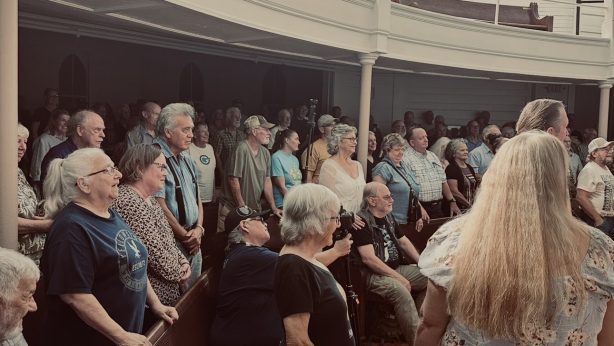
I partnered with Mr. Manuel Ayala in his Pláticas Musicales Event. My dad and uncle made pan de campo. We gave a short presentation and a tasting at the library.
Rey Torres learned how to make pan de campo from his dad: “The pan de campo he made was made in the oven. I never saw him make it outside with coals, but that’s where I first started learning about pan de campo.”
After he married my mom, my dad learned how to make pan de campo outside from my grandfather, José Solis.
“His pan de campo was not in the oven. It was out in the field with coals from mesquite or firewood. We would have anywhere from three to four skillets going on at the same time, keeping the temperature as constant as we could by adding brasas, or coals, to the skillet because each skillet required coals underneath the skillet. And the skillets that we used were those that had a top where the coals could be put on top to keep a constant temperature. It became an oven. So those were some of my first experiences working with my father-in-law, José Solis.”


Our Second Community Event at the Ethel Eyerly Senior Center
April 20, 2024
For the second event, I partnered with the Ethel Eyerly Senior Center to showcase the traditional Texan bread, pan de campo. Reynaldo Torres did a presentation and demonstration at the beginning of the workshop. The senior citizens and the community were invited to this event. Richard Solis and Rey Torres made pan de campo for the free event. I made chili to go along with the bread, and my aunt, Henrietta Solis, made beans. She makes the best beans! There was nothing left over after the event!
If you ever visit Kingsville, Texas, go visit the King Ranch Museum. It has a lot of South Texas history, and also has pictures of my family’s history.
The best part of documenting my family’s history was bringing the family together.
As Richard Solis said in his interview, “If we have family, we should teach the younger generation about the things that we used to do in the past. Because once you forget, they’re gone. And, that’s the saddest part.”
I always say life’s too short. We never know when it’s our time. No regrets. Know what lights you up. Spend time with your loved ones. And one last thing: Live life like a double rainbow!

Thank you to Pixabay.com for some of my sound effects in my podcast!
Related Websites:
King Ranch Museum
Elizabeth Barger YouTube Channel
Recipes:
King Ranch Cookbook
Texas Monthly Pan de Campo Recipe
Ranch Hand Breakfast
South Texas Weekly: Tejano Cookers (2009)


![[Laura Yohualtlahuiz] wears an elaborate Mexica danza headdress with long feathers radiating outward in orange, red, and pink alongside brown-and-white patterned feathers. A beaded headband with colorful floral and geometric designs frames her face, which is marked with red linear face paint. She wears a gold septum ring and shell earrings, with a tattoo visible on one arm and a green and yellow patterned top. Warm lights glow in the background.](https://texasfolklife.org/wp-content/uploads/2026/08/Laura_Atlachinolli-614x346.jpg)