Yiddish Life through Song: When Memory Becomes Performance

Yiddish Life through Song: When Memory Becomes Performance
by Samantha Goldberg Blackthorn, Texas Folklife Community Folklife Fellow
The Project and the Community
This project began as a long-term collaboration between myself and my community rooted in Jewish (Yiddish) folklife, Yiddish song, and survivor testimony. At its center is a woman who survived the Holocaust, lived as a partisan in the woods resisting the nazi occupation, and rebuilt her life after the war. Over years of interviews, visits, shared meals, music-making, and storytelling, what started as ethnographic documentation became something far more personal. By the time she passed away in 2026 at 99 years old, she was family.
The broader community tradition this work engages with is Yiddish cultural life as it survives through song, oral storytelling, humor, ritual, and memory practices shared across generations, especially within post-Holocaust Jewish diaspora communities and among their descendants, artists, and cultural workers.
While Sally’s story became the heart of this project, it was never hers alone. The work exists within a larger network of Yiddish musicians, storytellers, translators, descendants of survivors, cultural organizations, and community members who continue to sustain Jewish cultural life. Through concerts, community gatherings, educational programs, and informal exchanges between generations, Yiddish culture remains a living tradition rather than a historical artifact. The performances created opportunities for elders, adults, and children to encounter these stories together, allowing memory to become a shared community experience rather than an individual act of remembrance.
When I first began this project, I imagined that much of my fieldwork would involve additional interviews with Sally herself. However, she passed away before I could complete that work. As a result, the project shifted in an unexpected direction. Instead of focusing solely on her voice, I began interviewing the musicians, puppet makers, set designers, Yiddish translators, and other artists who had participated in bringing her story to life.
What I discovered surprised me. We often create ambitious community art projects together and then move immediately on to the next task without taking time to reflect on what the work meant to each person involved. Through these conversations, I learned how deeply Sally’s story had affected the people around her. None of them had the same relationship with Sally that I did, yet each had spent years living inside her story through music, translation, performance, visual art, and collaboration. Their reflections revealed that memory was not located in one person alone, but had become distributed across an entire community of people who helped interpret, sustain, and carry it forward.
How I Came to This Work
My interest in this tradition did not begin in academia. I was born into a Jewish family composed of Holocaust survivors, immigrants, and Yiddish speakers, and even as a child I was concerned with Jewish resistance during the Holocaust. I wanted to know whether Jews had fought back. I never heard those stories. I searched encyclopedias and libraries but found very little. I learned about non-Jews who hid Jewish people, forged papers for Jewish people, or employed Jews, but found little evidence of Jewish resistance itself. Because of this absence, I came to believe that we had not resisted, and as a young Jewish girl, that belief filled me with shame.
As I later discovered the extensive history of Jewish resistance, that shame turned into a hunger to share those stories with my peers and younger generations so they would know that Jewish life included resistance, survival, and strength. After years of studying Jewish resistance through lived experience, playing with “The Holocaust Survivor Band,” speaking with my own family, traveling through Poland with a Holocaust survivor, and learning songs of resistance, I decided I was ready to begin sharing these stories publicly. I chose live music, multimedia performance, and puppetry as the medium.
That decision led me to meet Sally Korn and ultimately shifted the work toward her life as a partisan. The meeting happened by chance. Sally’s son was attending one of my yoga classes. When I greeted him with “Shalom,” he asked whether I spoke Yiddish. During our conversation, I asked if there was any chance his mother had been a partisan.
He replied, “Well, yes, but she won’t talk about it.” I answered, “You don’t know me, but help us get together.”
When we first met for lunch, he was right: she did not mention the war. She did, however, unknowingly name the project during that first lunch when she said to me:
“Samantha, do not romanticize the life of a partisan. There is no pride in what we had to do to survive. Existence is Resistance.” Then we let the subject go.
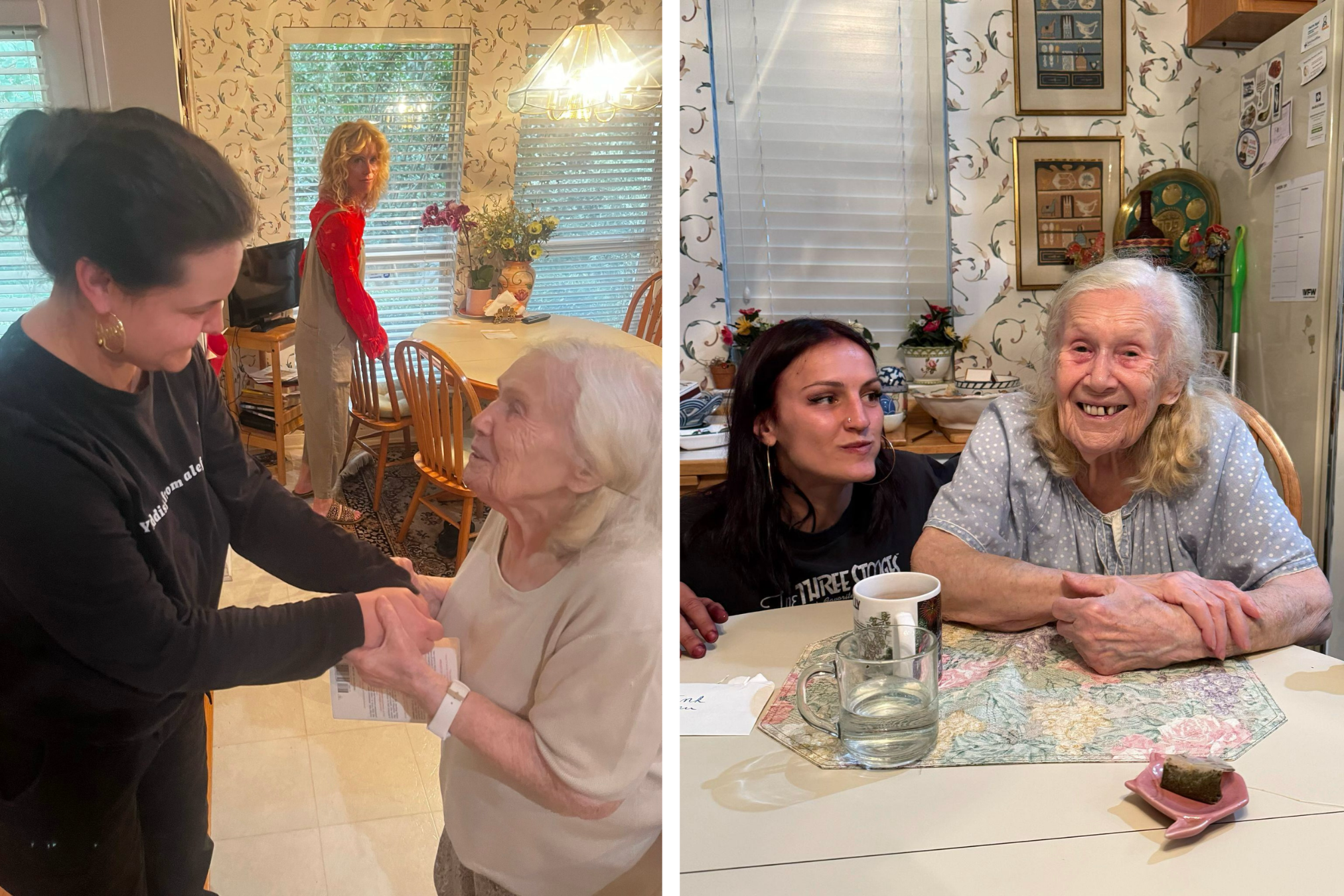
Instead, we spent time together. We shared Yiddish songs and language, watched old Yiddish VHS tapes, exchanged Yiddish jokes, and ate meals together. I often brought my daughter, and the two of them formed a strong bond. What began as interviews became family lunches, afternoons of songs and stories, and eventually simply being in one another’s presence. Over time, the boundary between documenting her story and participating in her life dissolved.
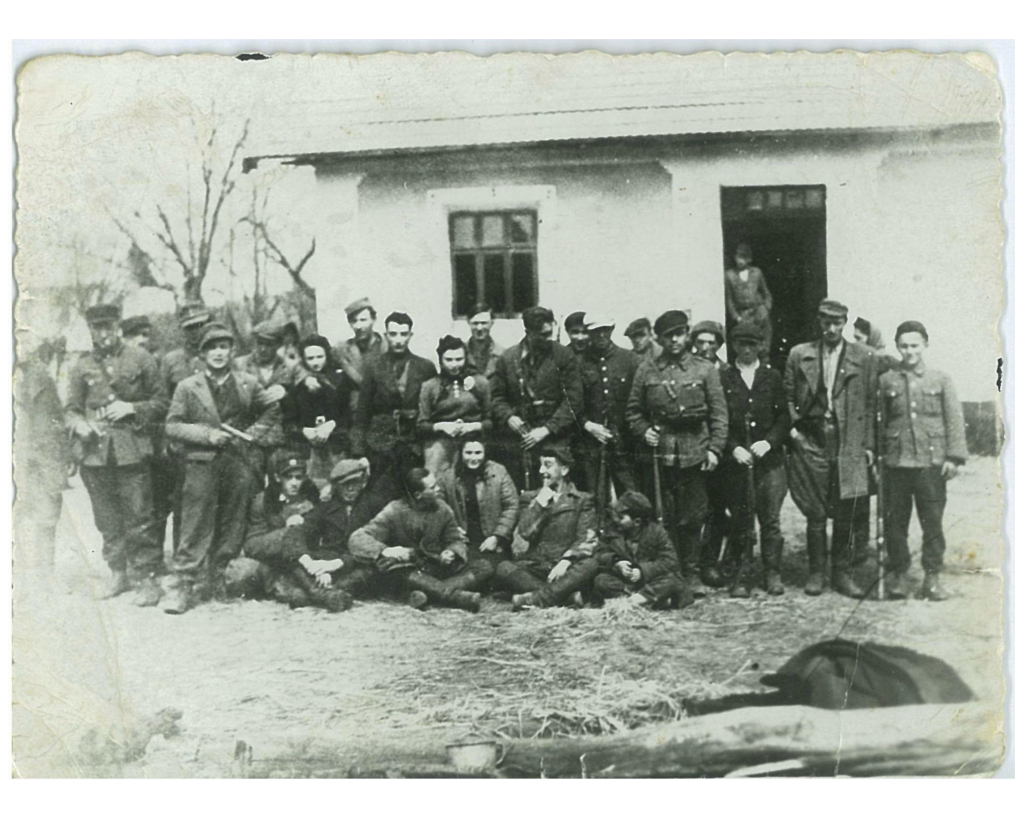
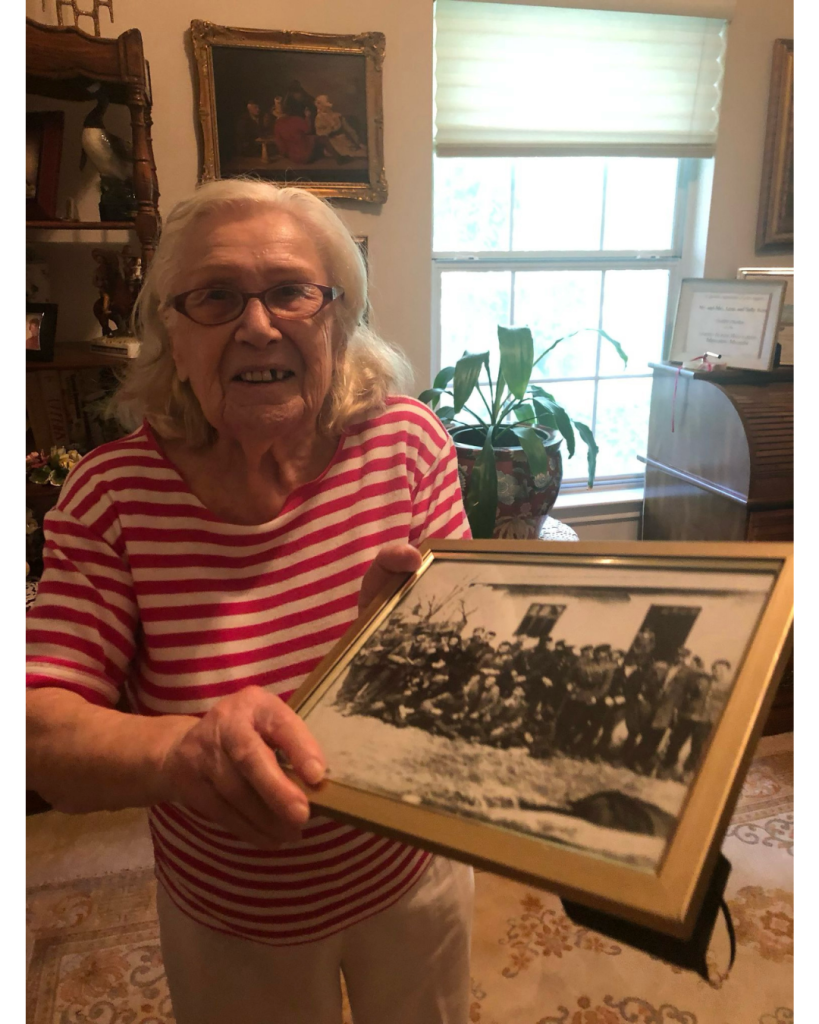
We did not simply record stories. We cooked without recipes. We learned songs in fragments. We sat with photographs that contained entire histories within them. One image in particular led me to center the puppet show entirely on Sally’s story. It was a photograph of her partisan group, taken by a Polish man who had hidden them after they were warned that the Nazis were coming. The photograph became a focal point for understanding survival, risk, and community.
Folklore as Lived Transmission
The tradition at the heart of this work is not folklore as static heritage, but folklore as a lived and living practice. Within Yiddish-speaking communities, particularly those disrupted by the Holocaust, culture survives through songs, stories, food, humor, ritual, and the countless small acts through which memory is shared across generations.
A central insight that emerged from this work is that folklore is not preserved so much as it is transmitted. It changes shape depending on who receives it, interprets it, and shares it. This became especially clear in the way Sally remembered her stories, not through linear narratives, but through rhythm, melody, and fragments of Yiddish songs and folktales that surfaced in conversation.
Songs such as “Oyfn Pripetshik” and “Tum Balalayke” were not simply performances or cultural artifacts; they were vehicles for memory itself. By singing them to us, Sally was not only recalling the past but actively transmitting it. Through song, memory moved between generations. We, in turn, continued singing those songs, sometimes adapting them to contemporary life while remaining connected to their origins.
Key Concepts and People
Several people and artistic roles shaped this project and, in turn, became part of the tradition it sought to sustain. At its center was the survivor-storyteller: a partisan fighter, Holocaust survivor, and keeper of memory whose life and experiences anchored the work. Surrounding her were musicians and translators who moved between Yiddish, English, and performance, helping songs and stories find new forms while remaining connected to their origins.
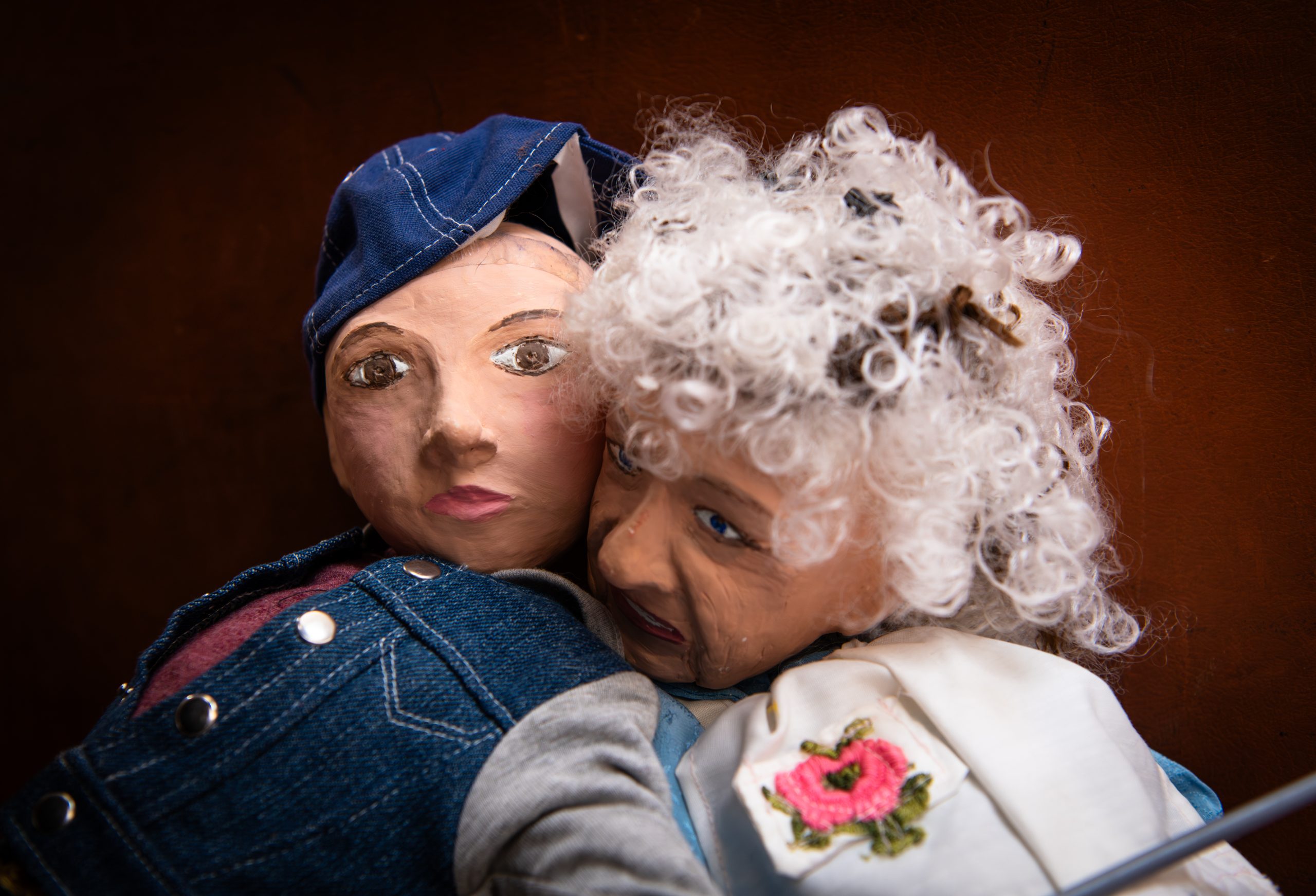
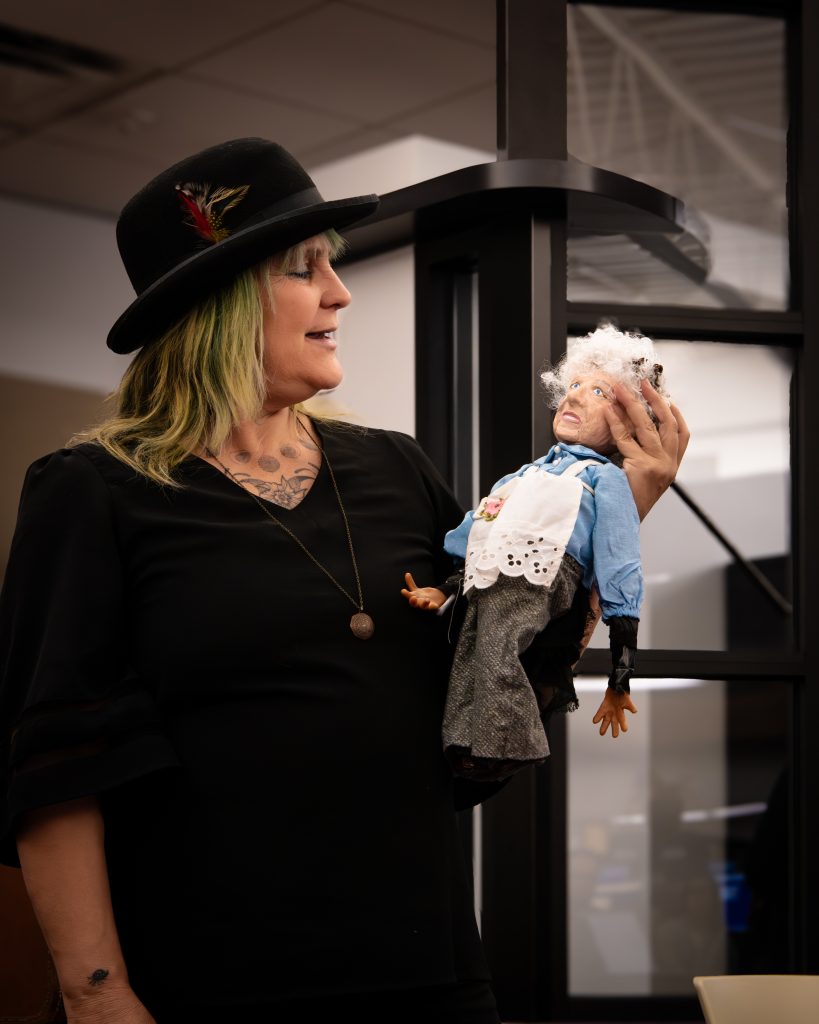
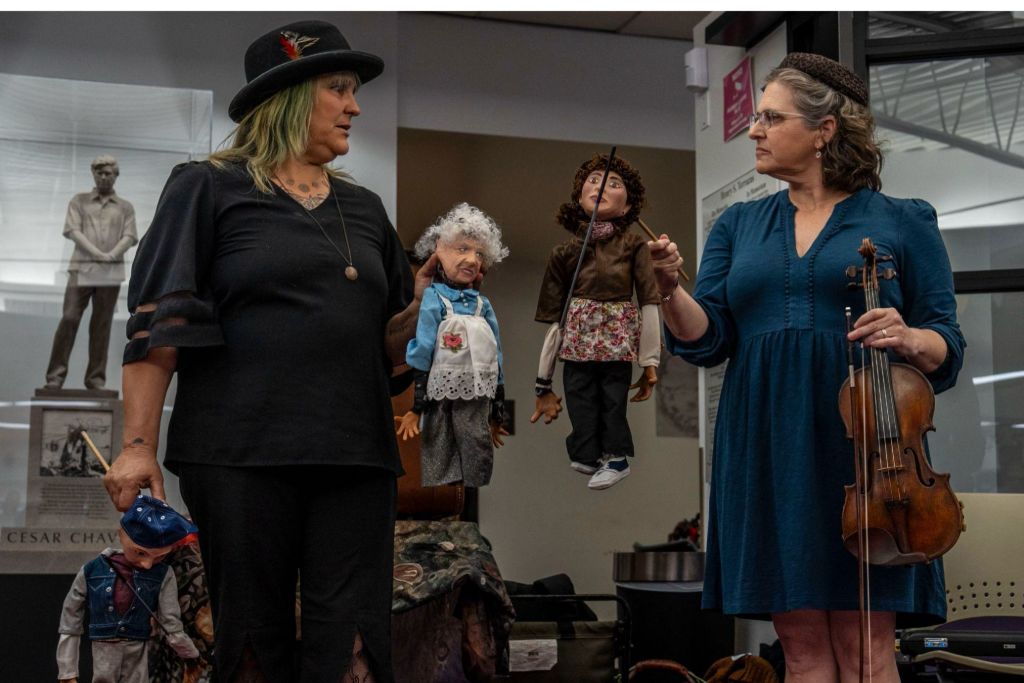
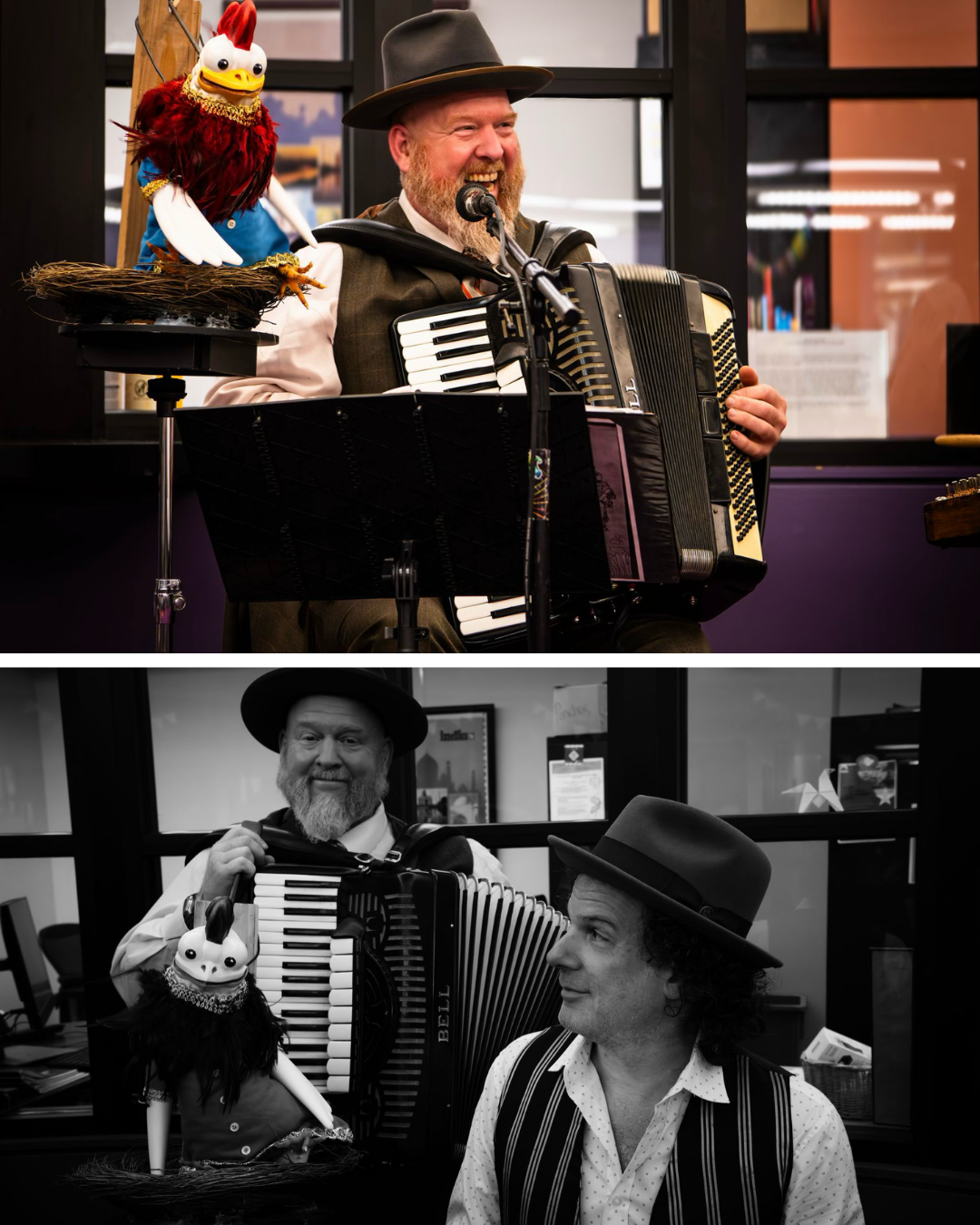
The project also drew on the figure of the badkhn, the traditional Jewish wedding jester, reimagined through the character of Mendel, a chicken puppet who could speak difficult truths through humor, play, and distance. Other puppet characters, including Samuel and granddaughter Shira, emerged through the intersection of music and storytelling, existing somewhere between instrument, performer, and persona. Shadow puppeteers, puppet builders, costume makers, and stage designers contributed another layer, creating visual representations of memory, loss, survival, and childhood experience.
These roles were not separate from the tradition itself. Rather, they became part of the ongoing process through which the tradition was interpreted, performed, and shared.
Exploration: Performance as Memory Transmission
At the center of this project is a live performance that combines Yiddish music, translation, shadow puppetry, and storytelling drawn from the survivor’s life. It has been performed in academic, community, and cultural settings, sometimes in Sally’s presence.
One of the most important discoveries in this process was realizing how performance transforms memory. The stories changed when they were sung, embodied, translated, and shared with an audience. Translation itself became more than a linguistic act; it was a form of cultural survival. When Yiddish songs were translated into English, choices had to be made about what could be preserved, what needed to be transformed, and what would inevitably be lost. The challenge was not only meaning but music, finding language that could carry the spirit of the song while still fitting its rhythm and melody.
Performance created other possibilities as well. Mendel, the badkhn chicken puppet, allowed difficult truths to be spoken through humor. Speaking through Mendel created a balance between distance and intimacy, making room for conversations that might not otherwise have been possible.
The puppets themselves became more than props. Built by hand, repaired over time, and brought from performance to performance, they became objects of memory. They held emotional weight, shaping how audiences encountered the story and, over time, how the performers related to it as well.
What emerged was not simply a representation of memory, but a living process of transmission in which music, Yiddish culture, family, story, objects, and relationships were inseparable. At a certain point, the work stopped feeling like interpretation and began to feel like shepherding folklore, being entrusted with something precious and helping it move from elders to children, from one generation to the next, and from memory into community.
Self-reflection: What This Process Changed
Working within this medium changed how I understand ethnography, performance, and memory itself.
I initially approached this work as a multimedia performance: collecting songs, recording narratives, and preserving history. Over time, it became clear that preservation was not the right frame. Nothing here was being kept intact. Instead, everything was being reshaped through relationship, lived experience, and contemporary conversations about the parallels between today’s political climate and the years leading up to the Shoah.
The most difficult and transformative realization was that folklore is not something outside of us. It exists only when it is actively shared between people.
Memory is not static, nor is it located solely in archives. It lives in bodies, voices, and repeated acts of care: singing a song again, even when parts have been forgotten; telling or listening to a story again, even when it has changed; rebuilding something again, even when it no longer resembles its original form.
This work also required learning how to remain present with difficult emotional material rather than moving too quickly beyond it. When working with survivor memory, the ethical responsibility is not only accuracy, but presence.
Conclusion: What Continues Forward
What remains from this project is not a finished work, but an ongoing practice of transmission.
The songs continue to be sung by new musicians. The puppets continue to be used, repaired, and rebuilt. The story continues to shift depending on who inherits it next.
What this project ultimately reveals is that folklore is not inherited in a fixed form. It is enacted in real time through performance, repetition, listening, and care.
The question is not simply what these stories mean.
The question is what happens when memory is held collectively, when it moves between people and, through that movement, becomes something new without losing its origins.
Looking back, I understand Sally’s words, “Existence is Resistance,” differently than I did when we first met. At the time, I understood them as a statement about survival. Now I understand them as a statement about cultural survival as well. The continued telling of stories, singing of songs, speaking of Yiddish, creating art, and gathering in community are all acts of resistance against forgetting. They are ways of ensuring that memory remains alive, not frozen in the past, but active in the present.
Although Sally is no longer with us, the work continues. The performances remain active, the songs continue to be taught and adapted, and the puppets continue to evolve through use and repair. The work is still being performed and continues to evolve through new audiences and contexts, including community spaces, cultural venues, and educational settings for teen and adult audiences. Future plans include additional performances, educational programming, and opportunities for audiences to engage with stories of Jewish resistance through music, storytelling, and community participation. In many ways, the project has become less about documenting a life and more about ensuring that the relationships, songs, and memories that shaped that life continue to find new audiences.
Because folklore is not what we keep.
It is what we refuse to let disappear.
Existence is Resistance video of select sections of a live performance of the puppet theater.
Podcast credits
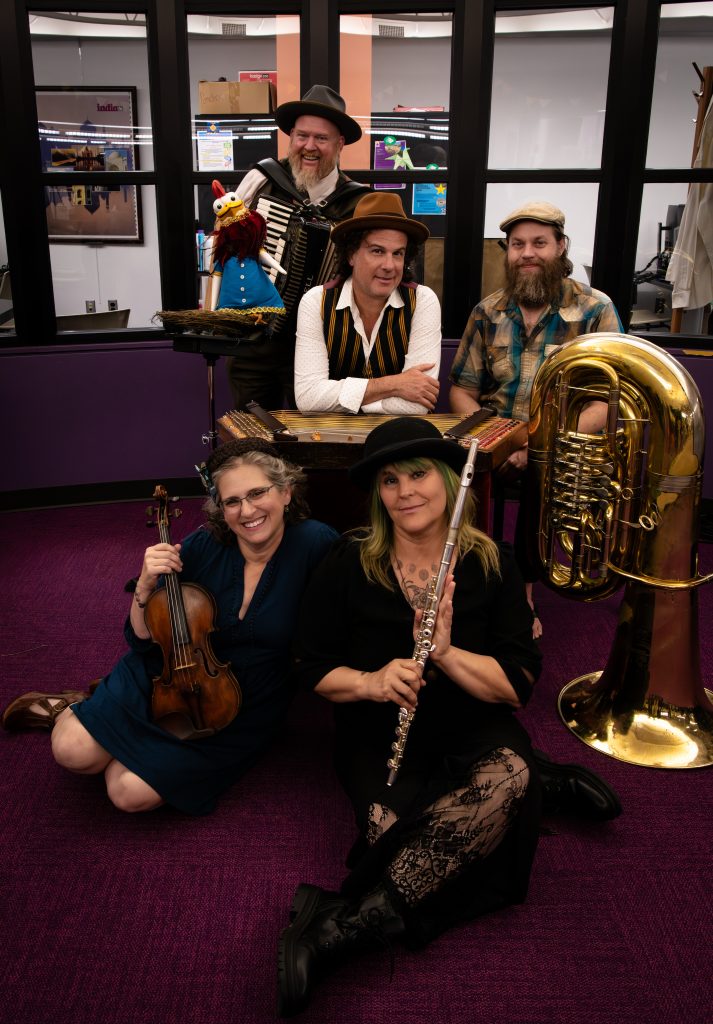
Written and Produced by Samantha Goldberg Blackthorn. Music performed by Mazel Tov Kocktail Hour. Interviews conducted by Samantha Goldberg Blackthorn. Recording by David Gilden, Samantha Goldberg Blackthorn, and Dylan Goldberg Blackthorn. Edited and mixed by Samantha Goldberg Blackthorn and Dylan Goldberg Blackthorn. Special thanks to Sally Korn, Stanton Korn and all those who shared their stories, memories, songs, and experiences that helped bring this project to life.
About Samantha Goldberg Blackthorn
Samantha (Goldberg Blackthorn) Saladino is a Texas-based musician, storyteller, multimedia performance curator and ethnographic artist documenting Holocaust testimony through oral history, travel, and performance. She enjoys incorporating live music and puppets into her projects. Her current project focuses on the life of a close friend who escaped a Nazi death camp, survived in the forest, and later fought in armed resistance. Through recorded interviews, site visits in Eastern Europe, and musical interpretation, she preserves and shares this history with new audiences.
She has traveled throughout Eastern Europe, Great Britain, and Latin America with Holocaust survivors, bringing and collecting Yiddish music and story in regions where these events took place and into contemporary cultural spaces. Her work centers on testimony as lived experience and on the responsibility of carrying forward survivor narratives with accuracy and care.
Samantha performs as a multi-instrumentalist with Mazel Tov Kocktail Hour (klezmer), Bereket (Persian and Arabic) and Blackthorn’s Rambling Mystics (Celtic music). As a self described wandering “Jewelsh” musician, she works across borders and traditions, using music as a vehicle for cultural memory, resistance history, and intergenerational exchange.
![[Laura Yohualtlahuiz] wears an elaborate Mexica danza headdress with long feathers radiating outward in orange, red, and pink alongside brown-and-white patterned feathers. A beaded headband with colorful floral and geometric designs frames her face, which is marked with red linear face paint. She wears a gold septum ring and shell earrings, with a tattoo visible on one arm and a green and yellow patterned top. Warm lights glow in the background.](https://texasfolklife.org/wp-content/uploads/2026/08/Laura_Atlachinolli-614x346.jpg)