Songs That Made Texas Home for South Asians

Songs That Made Texas Home for South Asians
by Sonny K. Mehta, Texas Folklife Community Folklife Fellow
One afternoon, I interviewed Dr. Nausha Asrar and Mr. Latafat Hussain outside on a ranch in southwest Houston. We spoke about Qawwali while sitting on farmland nearly forty minutes from the city’s South Asian centers. A few days later, I sat with Mr. Ravinder Goel inside Houston’s oldest Hindu temple while prayers unfolded in the background. Another interview took place in Mrs. Rathna Kumar’s home while someone worked quietly on plants outside her window. I realized that music in Houston wasn’t confined by walls in a certain type of building. It was in homes, but also in borrowed apartment clubhouses, and even more surprisingly churches.
I began this project thinking I was documenting devotional music traditions. But after spending time with these community members, I noticed that I was notating how our immigrant communities were building a new home in Texas, before they could fathom actually building temples and Gurudwaras and mosques.
Again and again, people remembered musical gatherings from forty and fifty years ago with incredible detail. They remembered apartment clubhouses, folding chairs, shared meals, handwritten songbooks, and gatherings that stretched late into the evening. Music wasn’t this far and hard to reach abstract thing., Rather it was part of the socializing that helped grease friendships.
Mr. Ravinder Goel described Bhajan gatherings happening in apartment complexes and church halls before Houston had the religious infrastructure many South Asians now take for granted. Mrs. Rathna Kumar remembered weekly gatherings in people’s homes where families sang together before eating dinner. Listening to them, I realized how much these gatherings functioned as community anchors for early immigrants. These were not polished performances. They were participatory spaces where people learned songs together, raised children together, and built friendships together.
One thing that surprised me most was hearing how different Houston’s soundscape once was. Today, Qawwali programs happen regularly across the city and are widely recognized by South Asian communities, even outside specifically Muslim audiences. But several interviewees described the 1970s and 1980s as a very different moment. Qawwali was not yet a large public-facing art form in Houston. The city was smaller.
The communities were smaller.
The musical spaces were too.
It was clear from the interviews that I couldn’t just group these traditions together, because that would flatten these religious, cultural and linguistic identities. Yes, they were all South Asian, but they were distinct and different.
Before beginning this project, I had not fully appreciated how participatory Bhajan traditions are. Mrs. Rathna Kumar described Bhajan gatherings as spaces where anyone could join regardless of musical training. The emphasis was not on perfection or performance. It was on collective participation. Listening to her, I began thinking differently about how devotional music creates community through singing together rather than simply listening.
My conversations about Shabad Kirtan also shifted my understanding of how deliberately music was placed at the center of Sikh community life in North America. Dr. Hardam Azad described how early immigrant gatherings often revolved around whoever in the community could sing. Later in the interview, he reflected on how Kirtan became central to growing and sustaining Sikh congregational life. One of the most memorable moments came when he laughed while remembering his children becoming completely absorbed in Kirtan performances even before fully understanding the language itself. His stories made clear that music could move children and highly accomplished adults alike.
Qawwali revealed another layer of complexity. Dr. Nausha Asrar spoke passionately about Qawwali’s relationship to classical music and devotion. One quote stayed with me long after the interview ended. He explained that even a newborn child, without understanding raag, melody, or musical theory, can still respond emotionally to music. That insight changed things for me, it shifted the earlier interviews for me. Across traditions, people repeatedly described music not simply as doctrine or instruction, but as something deeply felt before it was intellectually understood.
Mr. Latafat Hussain also complicated my assumptions about audiences and listening. He described how Indian and Pakistani audiences often appreciated different styles of Qawwali and responded differently during performances. It made me think about how migration reshapes listening and experiencing itself. Even within a broad South Asian identity, communities carry different musical expectations, memories, and relationships to performance.
In many ways, Houston feels like the right place for this story. The city now contains one of the country’s largest and most diverse South Asian populations, shaped by decades of migration after changes to U.S. immigration law in 1965. But these interviews also reminded me that Texas is often more diverse and more welcoming than national political rhetoric allows people to imagine. Several interviewees described these musical spaces as environments where people could fully inhabit their religious and cultural identities without fear of judgment. Listening to them, I realized many of these gatherings were treated with the same reverence people often reserve for formal religious institutions themselves.
At the same time, many interviewees also described tensions and changes taking place today. One recurring concern was the shift from participation toward performance. Bhajans and Shabads that once centered collective singing increasingly move toward staged presentation and online circulation. Qawwali, too, is sometimes flattened into spectacle or reduced to familiar Bollywood imagery rather than appreciated for its devotional and poetic depth.
Another tension involved institutionalization itself. Several interviews suggested that devotional music traditions once existed more independently within community life, while today they are often shaped heavily by larger religious organizations and institutional priorities. In some cases, interviewees implied that when music no longer serves institutional goals, it becomes secondary or disappears from communal practice altogether.
Still, what stayed with me most after these interviews was admiration. These early immigrants built communities, with very little. Before large temples, before major cultural centers, before social media networks, they carried these musical traditions into homes, apartments, and borrowed halls across Texas. They recreated soundscapes from elsewhere while also reshaping them into something distinctly tied to Houston and the American South.
And through all of it, music remained.
Far from home, it was comfort,
it was participation,
it became memory, and
it was a way of recognizing one another.
It was identity.
Project Description
This project documents how South Asian Texans sustain interfaith devotional music traditions through Qawwali, Bhajan, and Shabad Kirtan in Greater Houston. Using oral history interviews and field recordings, the project highlights how music fosters belonging, continuity, and coexistence within migrant communities.
About Sonny K. Mehta
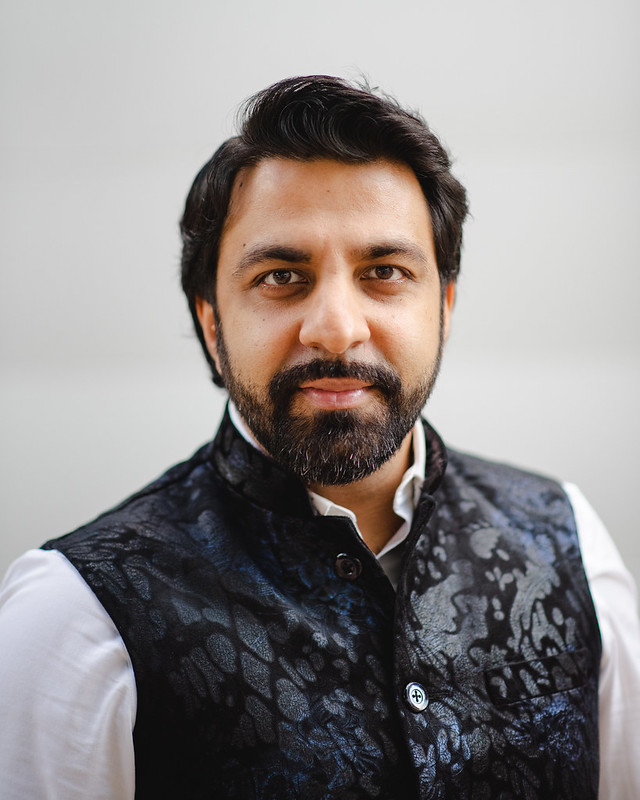
Sonny K. Mehta is a Houston-based Qawwali musician, educator, and community documentarian whose work centers on South Asian devotional music and interfaith collaboration. Active for over two decades, he has performed and taught Qawwali across the country, working closely with Hindu, Sikh, Muslim, and Christian artists to explore how sacred music travels, adapts, and builds belonging in diaspora communities.
Sonny’s practice bridges performance and oral history, combining interviews, and digital storytelling to preserve living traditions rooted in community participation. His documentation focuses on gatherings where music functions as devotion, memory, and social connection. Through the Folk Faiths of Texas project, Sonny seeks to record and share how South Asian Texans sustain plural devotional music practices, creating archival resources that reflect Texas’s everyday interfaith coexistence.
Social media
www.instagram.com/riyaazqawwali/
https://www.youtube.com/riyaazqawwali